Dorset Council Local Plan - scoping consultation 2026

Closes 26 Oct 2026

5. Key planning issues for Dorset

5.1.    Introduction

5.1.1.    The new local plan will focus on Dorset’s local planning issues. It will include a strategy for managing development across Dorset, including the provision of homes and employment development. It will be aligned with the Dorset Council Plan and complement the ‘National Decision-Making Policies’ contained in the NPPF which deal with many of the more general planning issues faced across the country.

5.1.2.    To identify some of the issues that the local plan needs to address, the local plan will be informed by:

  • a ‘baselining’ exercise that will review Dorset’s environmental, economic and social characteristics
  • the council’s priorities
  • the vision being developed to guide the local plan
  • evidence gathered by the council as part of plan making. 

5.1.3.    You can view some of the data that will inform the plan on the Dorset Council website.

5.1.4.    The sections below summarise the key planning issues that affect Dorset.

For reference, the list below identifies the key planning issues that are considered in this section. Open the list to view which issues are covered and then scroll to the relevant sections below.

Show the key planning issues for Dorset section list

5.2. Meeting the challenge of climate change
5.3. Delivering a sufficient supply of homes
5.4. Building a strong, effective economy
5.5. Ensuring the vitality of town centres
5.6. Securing clean energy and water
5.7. Making effective use of land    
5.8. Protecting Green Belt land
5.9. Achieving well-designed places
5.10. Promoting sustainable transport
5.11. Promoting healthy communities
5.12. Pollution, public protection and security
5.13. Managing flood risk and coastal change
5.14. Conserving and enhancing the natural environment
5.15. Conserving and enhancing the historic environment
5.16. Local waste facilities    
5.17. Other topics for the local plan to cover

Select 'Show more information' on each section below to read local context, a summary of national policy, and what the local plan can do in relation to the issue.

5.2. Meeting the challenge of climate change

The local plan will need to include a strategy and policies that meet new national policy requirements. This means it will need to support the delivery of new homes, jobs, infrastructure and services while helping Dorset mitigate climate change through transition to net zero.

Show more information

Local context

5.2.1.    The Dorset Council Plan (2024 to 2029) recognises climate change as one of the most urgent challenges facing the world today and sets out commitments to cut emissions and prepare for the impacts. Forecast impacts that have implications for new development in Dorset include: 

  • accelerated coastal change and erosion
  • rising sea levels, with particular implications for Dorset’s coastal communities  
  • increased flood risk, linked to extreme weather events becoming more common 
  • higher average temperatures and more intense summer heatwaves, with implications for health, design, trees, green infrastructure, water demand and fire risk
  • pressure on water resources, water quality, biodiversity and landscapes

5.2.2.    Many specific issues that relate to climate change, such as flooding and coastal change, are dealt with in more detail in other sections of this document.

National planning policy 

5.2.3.    National policy covers climate change mitigation and adaption matters relevant to planning application proposals such as: 

  • use of design approaches which conserve energy and other resources 
  • re-use of existing structures and materials
  • drawing low carbon energy from decentralised networks
  • sensitive creation or restoration of habitats which act as carbon stores
  • not increasing extraction of fossil fuels
  • improving energy efficiency of existing buildings
  • design approaches that minimise overheating risks
  • mitigation of wildfire risks

5.2.4.    The local plan does not need to repeat detailed policy on these matters.

5.2.5.    However, national policy requires local plans to take a proactive approach to mitigating climate change and supporting the transition to net zero. For Dorset, this means the local plan will need to:

  • propose sustainable patterns of development that will help radically reduce emissions, avoid vulnerability and improve resilience;
  • respond to specific climate change risks on existing communities and related to development allocations;
  • set local water efficiency standards where justified; and
  • identify green infrastructure and natural solutions for carbon storage and nature recovery and resilience

New local plan

5.2.6.    The local plan will need to include a strategy and policies that meet the new national policy requirements. This means it will need to support the delivery of new homes, jobs, infrastructure and services while helping Dorset mitigate climate change through transition to net zero. This will involve choices about where development should go, how places should be designed, and other approaches to tackle and adapt to climate change. 

Question 8: Are there any locally specific climate change issues that are not addressed by national policy and should be considered in the Local Plan?
There is a limit of 3000 characters
5.3. Delivering a sufficient supply of homes

The local plan will need to plan for a significant increase in housing delivery while also ensuring that new homes are the right type, tenure, size and location.

Show more information

Local context

Overall housing need and supply

5.3.1.    Dorset’s housing need increased substantially after the government updated the formula for calculating need ‘the standard method’ which must be used. The ‘standard method’ is defined in Annex D of the NPPF, which states that it should be used to calculate the overall number of homes needed in an area as a minimum over the local plan period. As a result, the local plan will need to plan for a major uplift in housing supply. The current calculated local housing need figure is 3,246 homes per year. If the plan was to cover a 15 year period from the 2028/29 adoption year to 2043/44 this would equate to 48,690 homes. Recent delivery has been much lower than this, so the scale, location and phasing of new development will be a key issue for the local plan. 

Photo of new homes in Dorset.

Specific housing needs

5.3.2.    The Dorset Housing Needs Assessment identifies that the need is not only for more homes overall, but also for the right mix of homes. It identifies that nearly half of the overall need is for affordable housing, with a particularly strong need for social rent. Dorset’s ageing population also has specific housing needs that, if met, could enable people to live independently for longer and open up much-needed family homes. The evidence also identifies a need for: 

  • affordable home ownership
  • housing for families, including larger affordable homes
  • homes for smaller households
  • accessible and adaptable homes
  • self-contained specialist older people’s housing units (including housing with support and housing with care)
  • housing for a several specific groups (care leavers, people who rent, essential workers, students and service families)
  • self-build and custom-build housing
  • Shared housing (Houses in Multiple Occupation)
  • Build to Rent housing, which is typically 100% rented out and professionally managed
  • Gypsy, Roma, Traveller and Travelling Showpeople sites

Second homes

5.3.3.    Second homes are a very localised but important issue in parts of Dorset. They are particularly prevalent in some coastal and National Landscape areas where significant numbers of new homes are unlikely to be appropriate. Studland has the highest proportion of second homes at around 27% and where second-home ownership is high, it can reduce the availability of homes for permanent occupation, affect affordability and weaken year-round community vitality. Second homes and short term holiday lettings can also positively contribute to local economies through local spending and by providing support for local jobs, as well as the tourism sector. 

National planning policy 

5.3.4.    National policy covers several matters around the following issues: 

  • meeting specific local needs for housing
  • affordable housing, including military affordable housing provision
  • specialist accommodation for older people, disabled people, community-based accommodation, and student and shared living accommodation
  • rural housing development providing affordable housing to meet local needs, and community-led developments, called ‘exception sites’
  • isolated homes in the countryside
  • Traveller sites 
  • speeding up time taken to build homes

5.3.5.    The local plan does not need to repeat detailed policy on these matters.

5.3.6.    However, national policy requires local plans to address the housing needs of different groups. For Dorset, this means the local plan will need to plan for the overall number of homes needed and for the right types and mix of homes. It will also need to consider the mix of tenures on larger sites and how different site sizes can contribute to housing delivery.

5.3.7.    National policy does not include specific policy for controlling second homes. This means a local policy for new homes could be considered if justified by evidence. If justified, it would likely need to be targeted to places where second-home ownership is affecting housing availability, affordability and community vitality.

New local plan

5.3.8.    The local plan will need to plan for a significant increase in housing delivery while also ensuring that new homes are the right type, tenure, size and location. This includes meeting overall housing need, maximising affordable housing delivery where viable, providing more social rent, supporting specialist and accessible housing, and ensuring that development is supported by infrastructure, services and sustainable transport options. 

5.3.9.    It is possible that a local plan policy which restricted occupation of new homes in specific areas to present their use as second homes could have a number of negative impacts. These could include impacts on the local construction and service sectors. To limit the potential adverse impacts consideration could be given to targeted second home restrictions which could apply in the most affected areas. The planning system cannot apply second home restrictions to existing homes meaning that the existing homes can still be purchased as second homes. However, where justified by evidence, policies can seek to control the occupation of new homes. Other forms of housing, such as ‘Build to Rent’, or housing provided through Community Land Trusts could also be supported by the local plan.

Question 9: Are there locally specific housing issues that are not addressed by national policy and should be considered in the Local Plan?
There is a limit of 3000 characters
5.4. Building a strong, effective economy

The local plan will need to support new jobs and investment while ensuring that employment land is provided in the right locations and in a form that can respond to changing business needs. The plan could also help support a sustainable visitor economy by guiding the location, scale and types of development that support tourism.

Show more information

Local context

Dorset's Economic Growth Strategy 2025 to 2040 

5.4.1.    Dorset Council has set out its priorities for economic growth, including:

  • defence, security marine and advanced engineering growth: encouraged around Dorset Innovation Park with a target of 300 new jobs and over 50 innovation community participants
  • growth in small and medium-sized enterprises and entrepreneurship: concentrating support for firms with the greatest potential for growth with a target for 1,000 business start up courses for 16 to 34 year olds
  • skills and development: investing in and improving educational and career routes in science, technology, engineering, and mathematics
  • growth in Dorset’s market towns and along transport corridors: through community led masterplans, repurposing town centre assets, affordable housing, and employment land allocations in coastal market and towns and A303 and A31corridors
  • tourism and visitor economy: increasing high-value, year-round visitor spending across Dorset by promoting its unique natural, cultural and leisure assets, strengthening partnerships, and supporting tourism and tourist infrastructure through the local plan, particularly where this helps diversify the type and location of tourist activity

5.4.2.    A key thread running through the priorities for economic growth in Dorset is the need for improved digital connectivity across the area. The Economic Growth Strategy identifies a need to embed digital technology across all sectors and facilitate investment in digital infrastructure.

Employment land

5.4.3.    The 2024 Employment Land Study pointed to a clear continuing need for employment land in the Dorset Council area to 2039, driven mainly by industrial, logistics, distribution and flexible business-space requirements rather than by large-scale office demand. The evidence on need for employment land is being refreshed as part of preparing the local plan. 

Photo of new employment units in Dorset.

5.4.4.    Some existing businesses may welcome opportunities to expand locally. The scope to support expansion of existing employment areas in Dorset’s market towns needs to be explored as part of the plan making process. Demand is particularly strong nearer to the BCP urban area and along the A31/A35 corridor, but the study also identifies demand at Blandford Forum, Dorchester, Weymouth and Sherborne. Secondary market towns outside the main economic centres are performing well economically, but rural viability and deliverability can be challenging. The local plan will therefore need to be realistic about where employment land can be brought forward and how the quality, flexibility and deliverability of employment land can be improved.

Tourism

5.4.5.    Tourism is an important part of Dorset’s economy and identity. The area’s coast, countryside, historic towns, villages, cultural assets and outdoor recreation opportunities attract large numbers of visitors each year.

National planning policy 

5.4.6.    National policy covers several matters relevant to planning application proposals around the following issues: 

  • supporting business growth
  • demonstration of unmet development needs
  • freight and logistics proposals
  • rural business development
  • tourism development outside settlements
  • rural business development
  • supporting improvements to digital connectivity that respect important environmental safeguards

5.4.7.    The local plan does not need to repeat detailed policy on these matters.

5.4.8.    However, national policy expects local plans to take a positive, proactive and realistic approach to long-term economic growth. For Dorset, this means the local plan will need to:

  • set a clear economic vision that amongst other things recognise the importance of tourism and the visitor economy
  • address barriers to investment
  • include development sites to meet unmet need and implement the economic vision and strategy
  • support modern and flexible premises
  • plan for storage and distribution where needed
  • avoid being unnecessarily restrictive about the types of employment uses that may be acceptable

New local plan

5.4.9.    The local plan will need to support new jobs and investment in line with the Dorset Economic Growth Strategy while ensuring that employment land is provided in the right locations and in a form that can respond to changing business needs. In practice, this is likely to mean:

  • safeguarding successful employment areas
  • allocating a realistic supply of deliverable employment land
  • supporting the expansion of existing businesses
  • planning for flexible industrial, logistics and business premises in locations that relate well to settlements, strategic corridors and local labour markets

5.4.10.    The local plan could also help support a sustainable visitor economy by guiding the location, scale and type of development that supports tourism including visitor accommodation, attractions, facilities and infrastructure.

Question 10: Are there locally specific economic issues that are not addressed by national policy and should be considered in the Local Plan?
There is a limit of 3000 characters
5.5. Ensuring the vitality of town centres

The local plan will need to support the long-term vitality and viability of town centres, while recognising that centres across Dorset perform different roles for communities and visitors.

Show more information

Local context

5.5.1.    Dorset has a varied network of town, district and local centres, serving communities across a large rural area as well as coastal and market town settings. These centres can provide access to shops, services, leisure, community and cultural facilities, employment and public transport, and many also support Dorset’s visitor economy. 

5.5.2.    The Dorset Council Town Centre Health Checks 2023/24 assessed the vitality and resilience of 37 town and district centres. Diversity of uses, vacancies, retail mix, rents, accessibility, the evening economy and development potential were considered. Weymouth, Dorchester, Bridport, Blandford Forum, Sherborne, Wimborne Minster, Swanage and Gillingham were found to provide the broadest range of retail, leisure, service and community functions. Tourism is also an important driver of vitality in several coastal and historic centres, including Weymouth, Lyme Regis, Swanage, Bridport and West Bay, Corfe Castle, Wareham, Sherborne and Shaftesbury.

National planning policy 

5.5.3.    National policy defines what centres are from a planning perspective, and covers several matters relevant to planning application proposals around the following issues: 

  • supporting the vitality and viability of centres
  • improving or retaining access to local shops and facilities that provide day-to-day services for local communities
  • focusing town centres development uses in centres
  • small scale rural development
  • retail and leisure development outside centres

5.5.4.    This means the local plan does not need to repeat detailed policy on these matters.

5.5.5.    However, national policy expects local plans to promote the long-term vitality and viability of town centres. For Dorset, this means the local plan will need to:

  • be informed by a strategy for town centres
  • set a hierarchy of town, district and local centres
  • define town centre boundaries and any areas where specific policies are needed
  • consider opportunities for a broader mix of uses, homes, intensification and re-use of vacant premises; identify suitable development sites in town centres first, then consider edge-of-centre or other accessible locations where needed
  • consider whether a local impact assessment threshold is needed for out-of-centre proposals
  • consider whether tools such as design guides, design codes, masterplans or restrictions on development types, called Article 4 Directions, are needed to support local character, vitality and viability

Photo of Dorchester town centre.

New local plan

5.5.6.    The local plan will need to support the long-term vitality and viability of town centres, while recognising that centres across Dorset perform different roles. Some centres provide a broad range of retail, leisure, service, cultural and community functions, some are strongly influenced by tourism, and some provide more local day-to-day services. The local plan will use the town centre health checks to help define the hierarchy of centres, review boundaries, identify opportunities for re-use and intensification, and decide whether local thresholds or locally specific policies are needed.

Question 11: Are there locally specific town centre issues that are not addressed by national policy and should be considered in the Local Plan?
There is a limit of 3000 characters
5.6. Securing clean energy and water

Informed by engagement with water companies and the Environment Agency, the local plan will need to support growth while ensuring that clean energy and water infrastructure are planned in a coordinated way.

Show more information

Local context

5.6.1.    New homes, jobs and services will need access to reliable energy, water supply, drainage and wastewater infrastructure, while the transition to renewable and low-carbon energy will require new generating capacity, storage and network connections.

Clean energy

5.6.2.    Dorset Council has identified investment in renewable energy technology and industry to be a priority in its Economic Growth Strategy. This will include offshore wind, hydrogen storage and production, carbon capture and storage, small modular reactors and data centres but the majority of these will be dealt with under the nationally significant infrastructure planning regime. Portland and Winfrith are identified as locations where investment could be focused with a target of at least 2,000 new jobs and £500 million private investment.

Water

5.6.3.    Parts of Dorset experience serious water stress. Interventions such as harvesting rainwater and creating localised reservoirs (such as for agriculture) may help to address water resource issues, and the council will need to closely engage with water companies and the Environment Agency about water supply, drainage and wastewater capacity. 

National planning policy 

5.6.4.    National policy covers several matters relevant to planning application proposals around the following issues: 

  • renewable and low-carbon energy development
  • electricity network infrastructure
  • battery storage and other energy infrastructure
  • water supply infrastructure
  • drainage and wastewater infrastructure
  • assessing the planning impacts of individual energy and water infrastructure proposals

5.6.5.    This means the local plan does not need to repeat detailed policy on these matters.

5.6.6.    However, national policy expects local plans to plan proactively for clean energy and water infrastructure. For Dorset, this means the local plan will need to:

  • be informed by early engagement with relevant organisations, considering impacts of planned growth, changing consumption patterns and climate change
  • support development needed for renewable and low-carbon energy, electricity network infrastructure, water supply, drainage and wastewater infrastructure
  • take measures to avoid development constraining infrastructure operation
  • identify areas for renewable and low carbon energy development and electricity network infrastructure

Photo of solar array in Dorset

New local plan

5.6.7.    Informed by engagement with water companies and the Environment Agency, the local plan will need to support new homes, jobs and services while ensuring that clean energy and water infrastructure are planned in a coordinated way. This will involve choices about where renewable energy and battery storage may be appropriate, how development should contribute towards infrastructure, and how water supply, drainage and wastewater capacity should be considered.

Question 12: Are there locally specific water and energy issues that are not addressed by national policy and should be considered in the Local Plan?
There is a limit of 3000 characters
5.7. Making effective use of land

The local plan will need to include a strategy and policies that proactively seek effective use of land, including by taking steps to ensure more compact, denser forms of development and redevelopment of underutilised sites. However, it will also need to ensure development is sympathetic to sensitive townscapes and landscapes and can accommodate required infrastructure.

Show more information

Local context

5.7.1.    Dorset’s towns and villages have grown over time and therefore feature many different styles and densities of development. 

Development densities

5.7.2.    Encouraging compact, ‘denser’ forms of development can help reduce the amount of greenfield land that needs to be developed, and reduce the need to travel if shops, employment, education and community facilities are also provided. However, care is needed to ensure development is sympathetic towards sensitive landscapes and townscapes. A balance also must be struck between optimising sites and ensuring any required on-site infrastructure, such as car parking and open space, can be accommodated well.

Brownfield sites

5.7.3.    Promoting redevelopment of brownfield sites can also help reduce the amount of greenfield land that needs to be developed. As a predominantly rural area Dorset generally has limited brownfield, especially when compared to many urban council areas. Brownfield land can also pose challenges when re-developing because of issues such as the need to remediate land, physical constraints, infrastructure problems and increased costs. 

National planning policy 

5.7.4.    National policy covers several matters relevant to planning application proposals around the following issues: 

  • promoting denser forms of development
  • requiring specific densities of residential development near railway stations
  • supporting proposals that remediate despoiled, degraded, derelict, contaminated or unstable land
  • making better use of vacant and under-utilised land and buildings
  • supporting proposals that feature temporary uses prior to permanent development
  • setting requirements for residential extensions

5.7.5.    This means the local plan does not need to repeat detailed policy on these matters.

5.7.6.    However, national policy expects local plans to take steps to ensure development makes efficient use of land. For Dorset, this means the local plan will need to:

  • use various methods to accommodate as much development on brownfield land as possible (this could include requiring minimum densities and redeveloping underutilised sites, like car parks and service yards)
  • make sure local plan development sites make effective use of land by promoting appropriately compact development and securing multiple benefits, such as new community facilities and habitat creation

New local plan

5.7.7.    The local plan will need to include a strategy and policies that proactively seek effective use of land, including by taking steps to ensure more compact, denser forms of development and redevelopment of underutilised sites. However, it will also need to ensure development is sympathetic to sensitive townscapes and landscapes and can accommodate required infrastructure. The issue of making effective use of land will also in part be addressed through the council’s emerging design code.

Question 13: Are there locally specific issues to do with making effective use of land that are not addressed by national policy and should be considered in the Local Plan?
There is a limit of 3000 characters
5.8. Protecting Green Belt land

The local plan will need to support growth while also protecting the most important functions of the Green Belt. This will include changing some Green Belt boundaries to enable development if needed. 

Show more information

Local context

5.8.1.    Green Belt is a planning designation that seeks to keep land permanently open and prevent the unrestricted spread of large built-up areas. In Dorset, Green Belt was designated in 1980 around the BCP urban area. It was established to help maintain the separate identity of towns and villages, prevent neighbouring settlements from merging, and to retain areas of open countryside around the conurbation.

5.8.2.    Today, the South East Dorset Green Belt continues to play an important role in shaping patterns of development in the south-east of the county. At the same time, Dorset faces significant housing, employment and infrastructure needs in this area, alongside ongoing challenges around housing affordability.

Map showing the Dorset Council area boundary and the extent of South East Dorset Green Belt.
Figure 3: Area of Dorset covered by Green Belt

National planning policy 

5.8.3.    National policy covers several matters relevant to planning application proposals around the following issues: 

  • what is considered to be inappropriate development in the Green Belt
  • renewable and low carbon energy development in the Green Belt
  • considering areas of ‘grey belt’ within the Green Belt (areas that don’t make a significant contribution to the Green Belt’s purposes)
  • areas where development may be possible, such as within ‘grey belt’ and near stations
  • the ‘Golden Rules’ for major housing development on land released from or brought forward in the Green Belt, including specific affordable housing and infrastructure requirements 

5.8.4.    This means the local plan does not need to repeat detailed policy on these matters.

5.8.5.    However, national policy expects local plans to:

  • not introduce new, or expand existing, Green Belt other than in unusual circumstances where this can be justified
  • make changes to Green Belt boundaries to meet development needs where justified, prioritising release of certain Green Belt areas (including grey belt)
  • make sure revised Green Belt boundaries meet a specified set of requirements
  • ensure major housing developments meet the ‘Golden Rules’
  • safeguard Green Belt land where it is needed to meet longer term development needs
  • promote benefits for communities and nature in remaining Green Belt land

New local plan

5.8.6.    The local plan will need to support new homes, jobs and infrastructure while also protecting the most important functions of the Green Belt. Given the scale of Dorset’s development needs, and the role of south-east Dorset as one of the more sustainable parts of the plan area, the local plan will need to consider changes to Green Belt boundaries.

5.8.7.    Changes to Green Belt boundaries will need to be informed by the findings of the 2026 Joint Green Belt Review. This identifies the contribution that different areas make to Green Belt purposes and whether land is grey belt. Any changes to the Green Belt will also need to be informed by a review of the sustainability of potential development locations, all other relevant planning issues, impacts on the strategic function of the Green Belt and the potential for remaining Green Belt land to provide wider benefits for communities and nature.
 

Question 14: Are there locally specific Green Belt issues that are not addressed by national policy and should be considered in the Local Plan?
There is a limit of 3000 characters
5.9. Achieving well-designed places

The local plan will need to support high-quality, well-designed developments and placemaking, alongside the new Dorset Design Guide which will provide more detailed local guidance on how new development should be designed. 

Show more information

Local context

5.9.1.    Dorset is made up of a wide range of places, including historic market towns, coastal settlements, villages and rural communities. These places have developed in different ways over time, shaped by the landscape, local building materials, street patterns, and relationship with the coast and countryside. New development needs to respond well to its surroundings.

5.9.2.    Good design is about more than how buildings look. It includes how places work for people: whether they are easy and safe to move around, whether public spaces are attractive and usable, whether development responds positively to local character, and whether it helps support healthy, inclusive and sustainable communities.

5.9.3.    The Dorset Design Code will provide more detailed local guidance on how new development should be designed. 

Photo of well-designed new homes in Dorset.

National planning policy 

5.9.4.    National policy covers several matters relevant to planning application proposals around the following issues: 

  • responding to local context while supporting innovation and change, particularly where it promotes high levels of sustainability or raises the standard of design in an area
  • creating liveable places
  • addressing climate change
  • providing green infrastructure
  • supporting movement and access
  • ensuring good quality built form and public space
  • creating strong, distinctive identity
  • refusing poorly designed development
  • using design review and other design processes 

5.9.5.    This means the local plan does not need to repeat detailed policy on these matters.

5.9.6.    However, national policy expects design expectations to be clearly set out in the local plans. For Dorset, this means the local plan will need to:

  • explain the design and placemaking outcomes sought locally
  • reflect design in the plan’s vision and spatial strategy
  • identify where design codes, design guides or masterplans are needed
  • set any locally specific design policies or standards
  • explain when design review or other design processes will be required

New local plan

5.9.7.    The local plan will need to support high-quality design and placemaking while avoiding unnecessary duplication of national policy. The local plan will also need to work closely with the Dorset Design Code but not repeat it. 

5.9.8.    A key issue is how much detail should be included in the local plan, and how much should be provided through the Dorset Design Code. The local plan could potentially set the overall design strategy for Dorset, identify the role of the Dorset Design Code, and explain where more detailed requirements in other forms of design policies and guidance will be needed. The Dorset Design Code could then provide more detailed guidance on matters such as local character, layout, materials, public spaces, movement, green infrastructure and climate-responsive design.

Question 15: Are there locally specific design issues that are not addressed by national policy and should be considered in the Local Plan?
There is a limit of 3000 characters
5.10. Promoting sustainable transport

The local plan will need to support new homes, jobs and services while also helping people travel in more sustainable ways where possible. This will be challenging in some parts of Dorset where many people rely on the car but development may still be needed.

Show more information

Local context

5.10.1.    The dispersed nature of Dorset’s towns and villages and the rural nature of much of the area makes achieving growth which realistically promotes sustainable travel challenging. Some (but not all) of Dorset’s main towns are connected by rail and bus services. However, many people rely on the car to access jobs, shops, schools, healthcare and other services due to limited public transport options, particularly in more rural areas. 

Sustainable location and design

5.10.2.    The sustainable location and design of new development can help reduce the need to travel long distances, support walking, wheeling and cycling, improve access to public transport, reduce reliance on car-based travel and enable the transition to lower-carbon, more efficient forms of transport. However, this has to be balanced with other considerations, such as the need to plan to meet housing needs, other planning considerations and opportunities for development.

Transport strategies

5.10.3.    Transport planning in Dorset is already being shaped by the Joint Local Transport Plan for Dorset and BCP, the Active Travel Infrastructure Plan, Bus Service Improvement Plan, and the emerging Rights of Way Improvement Plan. These plans seek to improve travel choices, support access to jobs and services, improve walking, wheeling and cycling routes, and make better use of Dorset’s rights of way and green links. 

Photo of segregated cycling infrastructure in Dorset.

National planning policy 

5.10.4.    National policy covers several matters relevant to planning application proposals around the following issues: 

  • locating development in sustainable places, where the need to travel is reduced 
  • mitigating significant adverse impacts on the transport network
  • taking environmental impacts into account
  • improving the sustainability of rural areas
  • street design and access, such as prioritising safe active travel movements
  • parking within development
  • roadside facilities, such as electric vehicle charging
  • transport assessments to assess impacts, and travel plans showing how sustainable transport will be achieved
  • marine ports, including their expansion and alteration
  • public rights of way 

5.10.5.    This means the local plan does not need to repeat detailed policy on these matters.

5.10.6.    However, national policy expects sustainable transport to form an integral part of a local plan’s strategy. For Dorset, this means the local plan will need to:

  • consider transport from the start
  • align growth with wider transport strategies and investment
  • use evidence when assessing potential development locations
  • support shorter journeys and mixed-use places where appropriate
  • identify important transport sites and routes that need to be protected

New local plan

5.10.7.    The local plan will need to support new homes, jobs and services while also helping people travel in more sustainable ways. This will be challenging in rural areas where public transport options are limited, but where some development may still be needed to meet Dorset’s housing and employment needs. The local plan will need to align with Dorset transport plans and strategies.
 

Question 16: Are there locally specific transport issues that are not addressed by national policy and should be considered in the Local Plan?
There is a limit of 3000 characters
5.11. Promoting healthy communities

The local plan will need to support growth while also helping to create healthy and inclusive communities and reduce inequalities. This will include identifying where there are needs, and where new development should provide or contribute towards new or improved provision.

Show more information

Local context

5.11.1.    Health and wellbeing are influenced by many factors, including: 

  • housing quality
  • employment
  • environmental conditions
  • access to nature
  • access to services
  • opportunities for physical activity, social interaction, leisure and healthy food choices
  • access to cultural and learning opportunities

5.11.2.    While land use planning cannot directly treat poor health or change personal behaviour, it can help shape many of the wider determinants of health through the location, design and infrastructure associated with new development. 

5.11.3.    Community facilities and infrastructure linked to Dorset’s culture, such as its museums, theatres, art galleries, and access to the natural environment are also important to the health and wellbeing of its residents, providing opportunities for leisure, learning, and promoting community pride. 

Health in Dorset

5.11.4.    Dorset’s population is, on average, typically healthier and longer lived than England as a whole, but healthy life expectancy varies across the area. Key challenges include an ageing population, rural isolation, poor access to services, housing affordability, long-term illness, poor mental health and physical inactivity. Some areas experience notable health deprivation, and the gap between life expectancy and healthy life expectancy remains significant. 

Benefits of new development

5.11.5.    New development can help meet the health and wellbeing needs of future residents by providing or contributing towards facilities and amenities such as open spaces, GP surgeries, schools, community halls, local shops and recreation (including play and sport opportunities). In some cases, additional residents can also help support the viability of existing facilities that may otherwise be at risk.

National planning policy 

5.11.6.    National policy covers several matters relevant to planning application proposals around the following issues: 

  • needs for improvements to community facilities and public service infrastructure
  • providing new and improved facilities
  • standards and best practice for quality and amount of recreational land and facilities
  • timely delivery of community infrastructure
  • considering health benefits
  • location of hot food takeaways
  • retaining key community facilities and recreational land
  • Local Green Spaces, these being green spaces of particular value to local communities

5.11.7.    This means the local plan does not need to repeat detailed policy on these matters.

5.11.8.    However, national policy expects local plans to promote healthy and inclusive places. For Dorset, this means the local plan will need to:

  • be based on an understanding of any existing deficit of facilities and services and future requirements
  • use the spatial strategy and development sites to promote good health, prevent ill-health, reduce health inequalities and support social interaction
  • set out expected facilities and contributions from development
  • identify land for community facilities and public service infrastructure where needed
  • set local outdoor recreation standards and protect important green spaces

Photo of new health centre in Dorset.

New local plan

5.11.9.    The local plan will need to support new homes, jobs and services while also helping to create healthy and inclusive communities and reduce inequalities. It will need to consider where community and cultural facilities, public service infrastructure, open spaces and recreation (including play and sport) opportunities are already available, where there are existing deficits, and where new development should provide or contribute towards new or improved provision. 

5.11.10.    This will be particularly important in rural areas, where some settlements have limited access to facilities and services, and growth could help support the long-term viability of existing provision.

Question 17: Are there locally specific health and wellbeing issues that are not addressed by national policy and should be considered in the Local Plan?
There is a limit of 3000 characters
5.12. Pollution, public protection and security

The local plan will need to make sure that development is suitable for its location and does not create unacceptable risks to health, living conditions, the environment, public safety or security.

Show more information

Local context

Pollution

5.12.1.    Pollution can affect health, living conditions, biodiversity and the wider environment. Most of the Dorset area benefits from generally good air quality. However, there are localised issues, including an Air Quality Management Area (AQMA) at Chideock along the A35 due to nitrogen dioxide. Other forms of pollution include noise and light pollution, and water and ground contamination. Some of Dorset’s natural habitats, including Poole Harbour and Chesil and The Fleet, suffer from nutrient pollution arising from agricultural run-off and treated wastewater discharges.

Crime and safety

5.12.2.    With regards to crime and fear of crime, the latest Dorset Community Safety Partnership plan states that crime in Dorset has tended to decrease annually since 2018, although crime levels vary by location and follow a seasonal pattern.

National planning policy 

5.12.3.    National policy covers several matters relevant to planning application proposals around the following issues: 

  • ground conditions, land instability and contamination, and remediation
  • healthy living conditions, including regarding pollution levels and daylight and sunlight
  • the relationship between new development and existing activities
  • public safety, security and major hazards, including where particular groups may be vulnerable to crime, or to the fear of crime – such as women and girls
  • land and operations required for defence and public protection

5.12.4.    This means the local plan does not need to repeat detailed policy on these matters.

5.12.5.    However, national policy expects local plans to:

  • identify development sites on land where environmental conditions can be improved, including through remediation
  • ensure development sites in the plan do not cause unacceptable pollution, put future occupiers at risk, or result in unreasonable restrictions on existing businesses, facilities and services
  • consider wider opportunities to reduce pollution
  • identify whether restrictions may be needed in some areas near hazardous sites
  • assess whether development for public safety and security is needed

New local plan

5.12.6.    The local plan will need to make sure that development is suitable for its location and does not create unacceptable risks to health, living conditions, the environment, public safety or security. As part of this it will be necessary to take account of and avoid the risks associated with difference sources of pollution. 

Question 18: Are there locally specific pollution, public protection and security issues that are not addressed by national policy and should be considered in the Local Plan?
There is a limit of 3000 characters
5.13. Managing flood risk and coastal change

The local plan will need to take a proactive approach to climate change, including long-term flood risk and coastal change, and will need to support measures such as space for protection or possible relocation of vulnerable development and infrastructure.

Show more information

Local context

Flood risk

5.13.1.    Flood risk affects large parts of Dorset. Flood risk may arise from different sources, including rivers, the sea, groundwater and surface water. Many of Dorset’s towns and villages are susceptible to the flood risks connected with rivers and surface water flooding. Coastal towns and communities are also vulnerable to the flood risks associated with the sea, including tidal flood risk and wave overtopping.

Map depicting the Dorset Council area boundary, areas at risk of river and surface water flooding, and areas that are expected to be at risk of flooding in future as a result of climate change.

Figure 4: Areas at risk of flooding in Dorset

5.13.2.    Climate change will likely increase flood risk over time, with flooding likely to become more frequent and, in some places, deeper, faster or more hazardous. Development should be guided away from areas at risk of flooding. However, in some cases development can help secure flood defences which benefit both new and existing communities. A study of the risk of flooding in Weymouth town centre has been prepared to better understand its vulnerability to flooding and to support its regeneration. A flood and coastal risk management scheme is being prepared which, if approved, will provide greater protection to over 1,000 properties and support regeneration of the town centre.

Coastal change

5.13.3.    Coastal change is a complex issue for Dorset’s coastline. Policies for the coastlines short, medium and long term management are set out in Dorset’s two Shoreline Management Plans. Some areas will be defended, particularly settlements, while other areas will either have managed adaption over time or be allowed to change naturally. Shoreline Management Plan policy and National Coastal Erosion Risk Mapping are used to define Coastal Change Management Areas (i.e. those areas subject to coastal change) in local plans. The Purbeck Local Plan already defines these areas for part of Dorset’s coastline. 

National planning policy 

5.13.4.    National policy covers several matters relevant to planning application proposals around the following issues: 

  • when assessments of flood risk are required
  • steering development towards areas that have the lowest risk of flooding
  • ensuring development is safe from flooding
  • ensuring development does not increase risk of flooding elsewhere
  • provision of sustainable drainage systems
  • development in Coastal Change Management Areas

5.13.5.    This means the local plan does not need to repeat detailed policy on these matters.

5.13.6.    However, national policy expects local plans to:

  • take a risk-based approach when identifying locations for development, steering development towards the areas at lowest risk
  • safeguard land that is, or is likely to be, required for flood management
  • use green and other infrastructure to reduce causes and impacts of flooding
  • relocate development that is expected to become unsustainable due to climate change
  • ensure effective alignment of land and marine planning to identify approaches to address long term coastal change and adaptation
  • define and set out policies to avoid inappropriate development in Coastal Change Management Areas

New local plan

5.13.7.    The local plan will need to take a proactive approach to climate change, including long-term flood risk and coastal change, and will need to support measures such as space for protection or possible relocation of vulnerable development and infrastructure. It will inform the location, scale and design of growth, identifying where development can be accommodated safely and where flood risk and coastal change constraints, adaptation needs or relocation pressures require a more specific response.

Question 19: Are there locally specific flood risk and coastal issues that are not addressed by national policy and should be considered in the Local Plan?
There is a limit of 3000 characters
5.14. Conserving and enhancing the natural environment

The local plan will need to support new homes, jobs and services while also protecting and improving Dorset’s natural environment, including its distinctive landscapes and valuable habitats.

Show more information

Local context

Dorset’s habitats

5.14.1.    Dorset’s natural environment is one of the area’s greatest assets. Its coast, heathlands, chalk streams, rivers, wetlands, grasslands, woodlands, hedgerows and urban green spaces support a wide range of habitats and species, some of which are nationally or internationally important. These assets are important in their own right, but also support wider social, economic and environmental benefits, including access to nature, flood management, climate resilience, and landscape character. 

Impacts of development on habitats and species

5.14.2.    Development can affect habitats and species directly, for example through land take or disturbance, and indirectly, for example through recreation pressure, drainage changes, lighting, pollution or fragmentation of wildlife corridors. It can also bring benefits by enhancing habitats, improving ecological connectivity and supporting rewilding efforts in areas where wildlife has been depleted. The Dorset Local Nature Recovery Strategy, a 10-year roadmap designed to reverse biodiversity decline and restore the natural environment, will form part of the local plan’s evidence base. 

Habitat sites

5.14.3.    Dorset contains ‘habitat sites’ that are of international importance, including the Dorset Heathlands and Poole Harbour. Some habitat sites are particularly sensitive to recreational pressure from new development, including dog walking and other informal recreation. This means that new development in affected areas often needs to avoid harm or provide mitigation such as suitable alternative natural greenspace (SANG). Other marine habitat sites may be affected by nutrient pollution in wastewater discharges, which may require different types of mitigation measure.
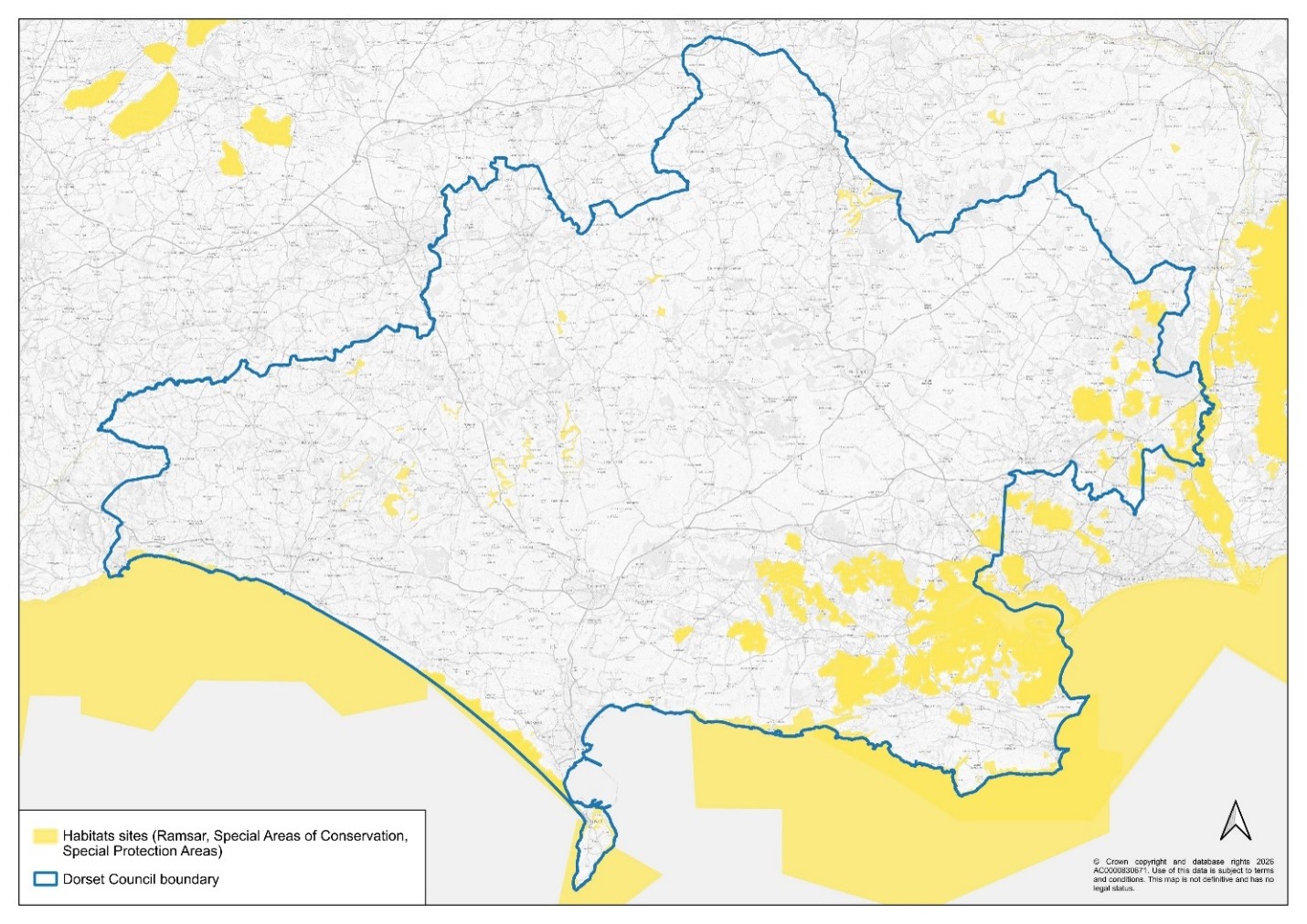
Map depicting the Dorset Council area boundary and the areas covered by habitat sites.

Figure 5: Dorset's habitat sites

Landscape

5.14.4.    Dorset has a rich and varied landscape. It includes dramatic coastlines, rolling chalk downs, river valleys, heathlands, woodlands and historic landscapes. These help create Dorset's distinctive sense of place and support biodiversity, tourism, and recreation. 

5.14.5.    A large part of Dorset is nationally recognised for its landscape quality, including the Dorset and Cranborne Chase National Landscapes. Dorset Council have a statutory duty to further the purposes of these designations when it makes decisions. The Jurassic Coast World Heritage Site, Purbeck Heritage Coast, West Dorset Heritage Coast and Dorset's undeveloped coast also form an important part of the county's identity. Careful consideration is required when determining how and to what degree new development, infrastructure, nature recovery needs and the transition to renewable energy should be accommodated in these areas. 

National planning policy 

5.14.6.    National policy covers several matters relevant to planning application proposals around the following issues: 

  • conserving and enhancing natural features of visual, historic or biodiversity value
  • agricultural land
  • connecting and strengthening ecological networks
  • green infrastructure, including securing multiple benefits
  • minimising negative impacts on biodiversity and support priority or threatened species
  • biodiversity net gain
  • trees, including tree-lined streets and practical considerations
  • protected landscapes, including location, scale and design of development 
  • maintaining the character of undeveloped areas of coast
  • suitability of development in areas of particular importance for biodiversity and geodiversity

5.14.7.    This means the local plan does not need to repeat detailed policy on these matters.

5.14.8.    However, national policy expects local plans to safeguard and enhance the natural environment. For Dorset, this means the local plan will need to use available evidence to:

  • set out a hierarchy of sites and areas that are important due to their landscape, geodiversity or biodiversity value
  • identify opportunities for the conservation, enhancement and recovery of landscapes, sensitive waterbodies, habitats and priority or threatened species
  • guide development towards less environmentally sensitive locations
  • set local green infrastructure standards 
  • consider whether specific development sites should make additional biodiversity provision

New local plan

5.14.9.    The local plan will need to support new homes, jobs and services while also protecting and improving Dorset’s natural environment. This will mean guiding development away from the most sensitive locations, identifying opportunities for nature recovery, and making sure that site allocations can address any biodiversity issues, particularly mitigation measures for habitat sites. 

5.14.10.    The local plan will also need to protect and enhance Dorset's distinctive landscapes. This will be particularly challenging in and around National Landscapes, along the coast, and on sensitive settlement edges where careful consideration will need to be given to how development could affect local character, views, tranquillity, dark skies or the setting of designated landscapes. 

Question 20: Are there locally specific natural environment issues that are not addressed by national policy and should be considered in the Local Plan?
There is a limit of 3000 characters
5.15. Conserving and enhancing the historic environment

The local plan will need to support growth while conserving and, where appropriate, enhancing the historic environment, including listed buildings, conservation areas, scheduled monuments and other heritage assets.

Show more information

Local context

5.15.1.    Dorset has a rich and varied historic environment, reflecting thousands of years of human activity. This historic environment plays an important role in the distinctive character and identity of Dorset’s towns, villages, countryside and coast.

5.15.2.    Many of Dorset’s heritage assets are designated in recognition of their significance. These assets include over 9,000 listed buildings, nearly 1,000 scheduled monuments, 36 registered parks and gardens, 179 conservation areas, 6 protected wreck sites off the Dorset coast and a world heritage site. Other heritage assets are not designated but are still important locally, including non-designated buildings, structures, places, spaces and archaeological remains. 

Photo of the listed Dorchester Brewery buildings and new development at Brewery Square.

National planning policy 

5.15.3.    National policy covers several matters relevant to planning application proposals around the following issues: 

  • how proposals affecting different types of heritage assets should be considered, including where they would result in harm to an asset
  • what heritage information applicants need to provide
  • how proposals that would result in the loss of a heritage asset should be considered

5.15.4.    This means the local plan does not need to repeat detailed policy on these matters.

5.15.5.    However, national policy expects local plans to deliver a positive strategy for the conservation, enhancement and enjoyment of the historic environment. For Dorset, this means the local plan will need to:

  • identify the area’s main heritage assets, including those that are most at threat
  • consider the wider benefits conservation of the historic environment can bring
  • promote development that draws on the contribution of the historic environment
  • identify non-designated heritage assets of importance to the local community
  • identify opportunities for development to enhance or better reveal significance of conservation areas and the Jurassic Coast World Heritage Site

New local plan

5.15.6.    The local plan will need to support growth while conserving and, where appropriate, enhancing the historic environment. This will involve understanding where heritage assets and their settings could be affected by growth, but also where development could help secure benefits, such as the repair, reuse or better appreciation of historic buildings, places and landscapes.

Question 21: Are there locally specific historic environment issues that are not addressed by national policy and should be considered in the Local Plan?
There is a limit of 3000 characters
5.16. Local waste facilities

The local plan is an opportunity to address some community-based waste infrastructure requirements.

Show more information

Local context

5.16.1.    Local waste facilities such as household recycling centres (HRCs) are needed to enable recycling of household waste. HRCs are important facilities that enable the council to manage bulky items, electricals and other material which cannot be disposed of in kerbside bins. They support Dorset in achieving recycling rates that are close to 60% through sorting and diversion from landfills. The council also has a network of waste depots which are essential to enable kerbside bins to be collected from homes. In some locations, existing HRCs need to be replaced as they are no longer fit for purpose. Elsewhere, there is a need for additional facilities. The network of waste depots also needs to be reviewed to enable an efficient and cost-effective approach to waste collection.

National planning policy 

5.16.2.    The NPPF states spatial development strategies should provide a positive vision for growth and change, whilst giving a clear spatial framework for investment and growth. This includes setting out requirements for strategic infrastructure needed to enable development, including strategic waste infrastructure. At the local level, specific sites will need to be identified to meet the need. The National Planning Policy for Waste (2014) guides the provision of waste management infrastructure to support the waste hierarchy – where waste is reused, recycled, recovered and disposed of as a last resort. 

New local plan

5.16.3.    The Waste Local Plan (2019), alongside the Minerals Site Plan (2019) and Minerals Strategy (2014), need to be reviewed. Growth delivered as part of the emerging local plan will require supporting infrastructure, which if not provided could worsen some of the local issues relating to the coverage of HRCs, depots and their capacity. The local plan is an opportunity to address some of these community-based waste infrastructure requirements.

5.16.4.    Larger waste infrastructure serves a much wider area than local waste facilities and would therefore need to be planned more strategically across the area they serve. Minerals issues are again strategic in nature and better addressed at a wider level.

Question 22: Should the local plan identify land for local waste facilities, including household recycling centres and depots?
There is a limit of 3000 characters
5.17. Other topics for the local plan to cover
Question 23: Are there any other topic areas that the Dorset Council Local Plan should cover?
There is a limit of 3000 characters